REVIEW · KRAKÓW
The best view of Krakow from Golf Cars
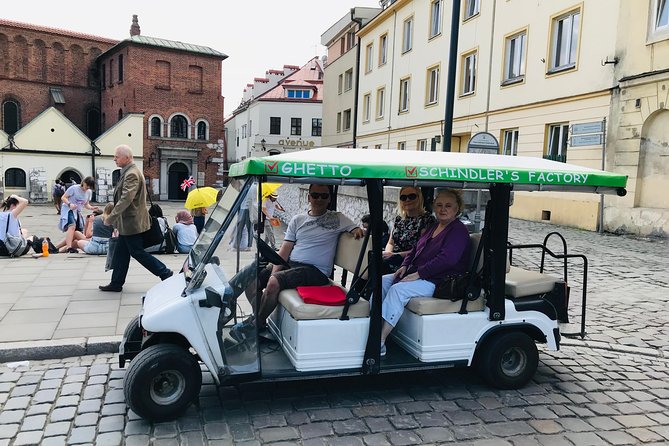
A golf cart makes Krakow feel walkable. You’ll zip between the Old Town and Kazimierz in an electric vehicle, with stops that reach places big buses usually skip, plus an audio guide in 26 languages. I like that the route stays tight to major sights while still getting you into lesser-visited corners.
Two things I particularly like: the small-group size (max 7), which keeps the pace human, and the driver-led context paired with audio so you get the why, not just the what. One drawback to consider: a small number of past bookings reported carts not arriving, so I’d plan this with a little buffer and be ready to troubleshoot quickly on the day.
In This Review
- Key highlights worth your attention
- Why a golf cart view makes Krakow easier to read
- The 2-hour loop: from a 1498 gate to Wawel’s UNESCO castle
- Wawel Hill highlights: dragon lore, Bernardine Church, and Church on the Rock
- Getting from Wawel to Kazimierz: Wolnica Square and the Father Bernatek Footbridge
- Kazimierz synagogue stops: Tempel, Stara Synagoga, Szeroka Street, and Remuh
- The Kraków Ghetto memorial section at Plac Bohaterow Getta
- Price and what $103.03 gets you for a group of up to 7
- Weather, timing, and the one reliability factor I’d watch
- Who this electric golf cart tour is best for
- Should you book this golf cart tour?
- FAQ
- How long is the Krakow tour by golf cart?
- How many people are in the group?
- What does the tour include?
- Does the tour offer pickup, and where does it start?
- Is the tour suitable for rainy or cold weather?
- Is food included?
Key highlights worth your attention
- Electric golf carts that can reach spots outside the big-bus route
- Max 7 people for a more personal pace and better chances for questions
- 26-language audio guide plus an English-speaking driver for layered storytelling
- Wawel Hill and dragon area are timed for a quick look without rushing you
- Kazimierz synagogue squares and ghetto sites in one continuous circuit
- Photo stops during the tour so you’re not stuck photographing while driving sights
Weighing this one up? Here is how it sits next to a few Krakow trips travellers book most.
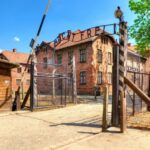
- From Krakow: Auschwitz-Birkenau Guided Tour & Hotel Pickup
★ 4.5 · 33,358 reviews - From Krakow: Auschwitz-Birkenau Guided Tour & Hotel Pickup
★ 4.5 · 29,340 reviews - Krakow: Auschwitz Guided Tour with Optional Hotel Pickup
★ 4.5 · 15,280 reviews
Why a golf cart view makes Krakow easier to read
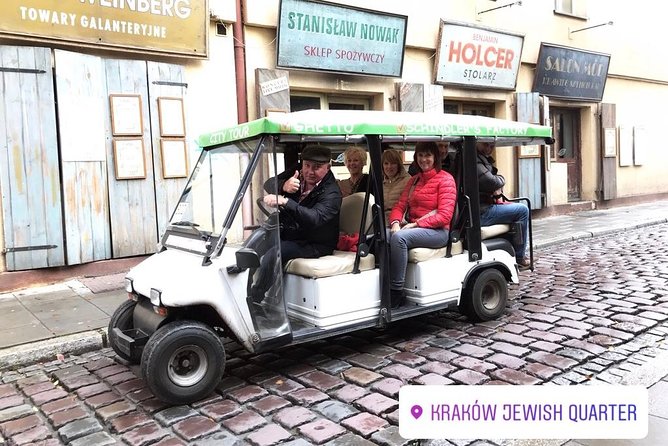
Krakow is the kind of city where the big sights can blur together if you’re bouncing around on your own. This tour fixes that by moving you in short jumps, then letting you pause at key landmarks long enough to actually connect the dots. From the cart, you also get a “big picture” angle of how Old Town and Kazimierz sit side by side along the river.
I also like the rhythm. You’re not spending the whole time walking through crowded streets, and you’re not parked in one place waiting for a slideshow. The golf carts are meant to keep your momentum, while the stops handle the details—Wawel Hill, river crossings, church fronts, and synagogue streets.
You get a guided experience with an audio layer, which is a smart combo for Krakow. The driver can explain what matters, while the audio guide keeps you on track when you want to focus on the architecture or the chronology. And since the audio system covers 26 languages, you’re not stuck with a one-size-fits-all script.
The 2-hour loop: from a 1498 gate to Wawel’s UNESCO castle
The tour is about two hours, which means it’s built for a first-day orientation. In that time, you’ll hit the landmarks that shape Krakow’s layout: the entry into the Old Town, the national monuments, the ring of green space around the old medieval walls, and the Wawel area that anchors the city.
Early on, you pass a historic gateway built around 1498, a classic Old Town threshold. This matters because it helps you understand Krakow’s core as something walled and defensive—not just a pretty cluster of buildings. Then comes the Grunwald Monument, which commemorates the Battle of Grunwald, one of the major medieval victories shared between Poland and Lithuania. It’s a different kind of landmark: more civic symbolism than architectural detail.
Next, you’ll see one of the city’s largest parks in Krakow that encircles the Old Town, where medieval city walls stood until the early 1800s. Even if you don’t walk into the park, the cart view gives you a quick mental map of where the old boundaries used to be. That context makes later stops in Kazimierz and around the ghetto sites feel more grounded in geography, not just a list of places.
Then you reach the big hitter: Wawel Castle, now a major art museum and a UNESCO World Heritage Site (as part of Krakow’s Historic Centre). This is where the tour earns its keep. In a short ride, you’re getting the central anchor of Polish state identity, not just a church façade.
Wawel Hill highlights: dragon lore, Bernardine Church, and Church on the Rock
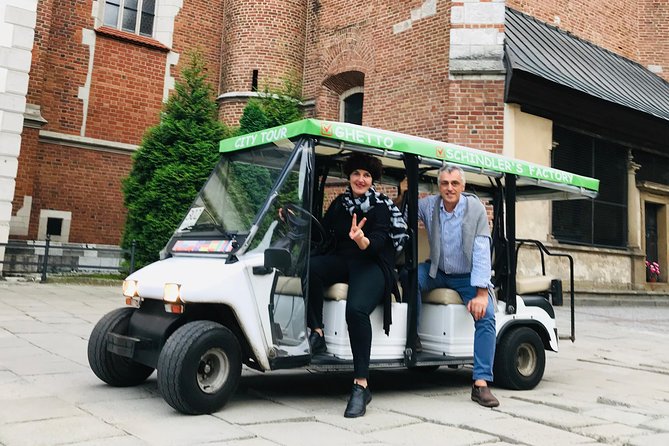
Once you’re at Wawel, the tour shifts from “view and context” to “quick cultural hits.” You’ll stop at the Monument of the Wawel Dragon, tied to Polish folklore, where the dragon is said to have had a lair in a cave near Wawel Hill by the Vistula River. It’s a short stop—about 10 minutes—but it’s a fun one, because it turns a famous story into something you can point at.
A little farther down the hill area, you’ll visit the Bernardine Church near Wawel. The current building dates to the second half of the 17th century, and the baroque church erected between 1719 and 1728 adds that distinct dramatic feel baroque churches are known for. If you love church interiors, you’ll probably wish for more time—but as an overview stop, it works.
Then comes Church on the Rock (Kosciol na Skalce), one of those Krakow sanctuaries that feels both old and surprisingly “alive.” The shrine has monastic connections dating back to Pauline Fathers since 1472, and it received baroque decoration later, from 1733 to 1751. The tour allows about 10 minutes here, and admission is listed as free—so you can pop in without worrying about an extra ticket.
This section is also practical for first-timers. Wawel Hill can be busy on foot. With the golf cart, you’re not fighting the whole climb with everyone else, and the story of Krakow’s power and faith lands faster because you’re not wandering lost through the whole area.
- Krakow: Wieliczka Salt Mine Tour with Entry Ticket★ 4.6 · 10,927 reviews
- Krakow–Zakopane: Cable Car, Chocholow Baths, Cheese & Vodka★ 5.0 · 10,720 reviews
- Krakow: Auschwitz-Birkenau Guided Tour with Pickup & Lunch★ 4.5 · 9,800 reviews
- From Krakow: Wieliczka Salt Mine Tour★ 4.6 · 9,393 reviews
Getting from Wawel to Kazimierz: Wolnica Square and the Father Bernatek Footbridge
The route then swings toward Kazimierz, and that shift is more than just a change of neighborhood. Kazimierz is where Krakow’s Jewish quarter story becomes central, and the tour builds that narrative step by step instead of dropping you in the middle of it with zero context.
You’ll pass Wolnica Square, described as part of the old market area in Kazimierz. Market squares matter because they show where people gathered for trade and daily life. From there, you cross the Father Bernatek Footbridge, which spans the Wisła River and links Kazimierz and Podgorze. The stop is about 5 minutes, free admission.
This short bridge stop is useful because it physically shows you how the neighborhoods relate across the river. Even if you don’t linger, you’ll leave with a clearer sense of where Kazimierz sits in the wider Krakow picture.
Next up is the Corpus Christi Church (Kosciol Bozego Ciala). The church is gothic, founded by King Casimir III the Great in 1335, and the interior combines Polish Gothic with impressive Polish Baroque elements. It’s another quick hit—about 10 minutes—but it gives you that sense of Krakow as layered: medieval structure plus later baroque drama.
Kazimierz synagogue stops: Tempel, Stara Synagoga, Szeroka Street, and Remuh
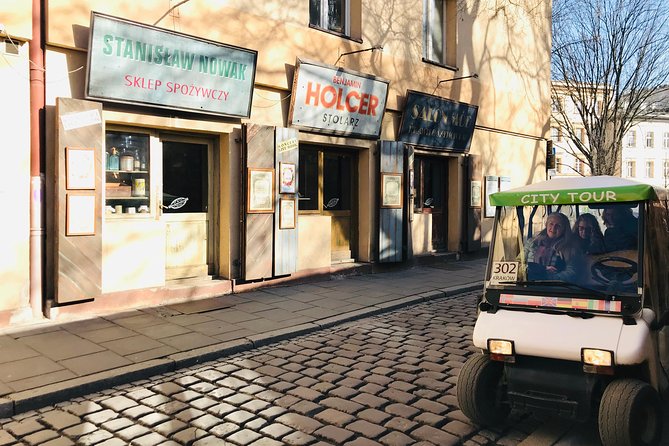
The Kazimierz portion is the heart of this tour. You’ll see multiple synagogue sites and the streets around them, and that helps you understand how this neighborhood functioned as a religious and cultural center.
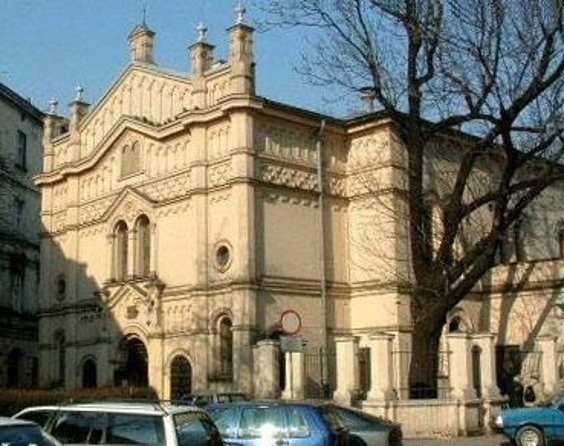
One stop is Tempel Synagogue, known as the Progressive Synagogue. The tour notes it was built in the 1860s, but it also includes historical references to earlier synagogue presence tied to dates such as 1640s devastation during the German occupation and a founding in the 1530s. Even if you’re not catching every date, the takeaway is clear: these sites weren’t one-off buildings—they were part of an evolving community and repeatedly impacted by major historical events.
You’ll then get time in Szeroka Street, described as the heart of Kazimierz’s Jewish district. The stop is about 10 minutes, and admission is free for this portion. This is the kind of street stop that helps you imagine everyday life, not just monuments. The area also includes mention of cultural events, meaning the streets aren’t purely museum-like—they’re still part of how the neighborhood lives.
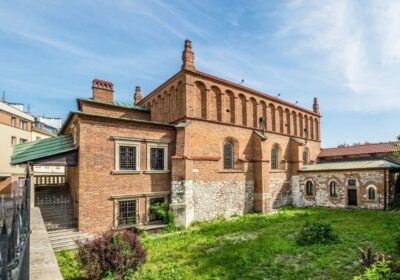
Another important stop is Muzeum Krakowa – Stara Synagoga. This is listed as the oldest synagogue, built either 1407 or 1492 (the date is given as one of those possibilities). You’ll be able to view a permanent exhibition of judaica, and admission is not included on the tour. Even without paying for the interior, just placing Stara Synagoga in your mental timeline is valuable: you’re seeing how far back this religious footprint goes.
The tour also visits Remuh Synagogue (Synagoga Remuh), described as a unique complex of Jewish architecture and sacred art from the mid-16th century that has remained a center of religious life. Admission isn’t included here either, but the stop time is about 10 minutes.
A bonus on the Kazimierz stops: the tour points out the Okrąglak in relation to Okrąglak market hall, built 1899–1900 and still one of the most characteristic elements around. That detail is great for photography and it helps you spot something distinctive if you return later on your own.
The Kraków Ghetto memorial section at Plac Bohaterow Getta
This is the part of the tour that turns from architecture and stories into remembrance. You’ll stop at Plac Bohaterow Getta, tied directly to the Kraków Ghetto—one of five major metropolitan Jewish ghettos created by Nazi Germany.
The stop is short—about 5 minutes—but it includes a strong set of reference points: the only pharmacy in the Kraków ghetto, which also has a museum exhibition (admission is not included), plus a fragment of the ghetto wall on Lwowska Street. The tour also notes where the ghetto entry gate was located during 1941–1943, branching from Podgorze Market Square at the start of Limanowskiego Street.
I appreciate tours that treat these sites with care and clarity, and the structure here helps. Instead of dumping you at one memorial and moving on, you get multiple anchor details tied to specific locations. If you want to go deeper afterward, these references make it easier to search for the right street, wall fragment, or memorial next.
Just keep your expectations straight: this section is brief by design. If you want a longer, more reflective experience, you’ll likely add a dedicated ghetto-focused visit on another day.
Price and what $103.03 gets you for a group of up to 7
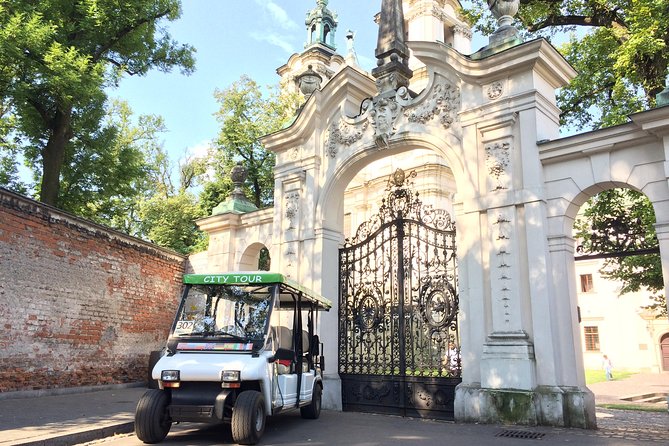
At $103.03 per group (up to 7), the value swings a lot depending on how many of you are traveling. With a full group, it works out to roughly $15 per person for a 2-hour guided circuit that includes an electric vehicle, an audio guide system in 26 languages, and photo stops.
For solo travelers or two people, it’s still a decent way to get efficient sightseeing, but it won’t feel like a bargain in the same way. Think of it less as a cheap ticket and more as paying for convenience plus narrative guidance. In Krakow, where walking between the right areas can eat up time, that “time saved” is part of what you’re buying.
Also consider the format. This isn’t a long bus ride with one big stop at the end. The pace is compact, and the stop list is designed to give you quick context across multiple districts—Old Town, Wawel Hill, Kazimierz, and the ghetto sites—within two hours.
Two small practical notes from the experience design: the tour offers pickup, uses a mobile ticket, and runs with an English-speaking driver alongside the audio system. If you’re traveling with kids, elders, or anyone who hates long walks, the golf cart format tends to feel like an advantage, not a compromise.
Weather, timing, and the one reliability factor I’d watch
The tour is described as operating on cold and rainy days thanks to special covers on the vehicles. At the same time, weather can still force changes if conditions are truly bad. So I’d treat this as a plan that can work in real-world weather, but keep a little flexibility in your schedule.
One more reality check: there have been reported issues where the golf carts reportedly did not turn up as expected. That’s not something you should ignore. I’d recommend booking this tour earlier in your Krakow stay, so you still have options if something goes sideways on timing. Then, give yourself some buffer around the start time so you’re not watching your watch all day.
Who this electric golf cart tour is best for
This tour fits best when you want structure without a long day. It’s ideal for first-time visitors who want the “shape” of Krakow fast, and for groups who prefer a guided route that still lets you pause and take in details.
It’s also a good match for travelers who like Jewish history and architectural variety, because the Kazimierz sequence is the core of the experience. You’ll see multiple synagogue-related stops and key street and square markers like Szeroka Street and the Okrąglak reference, plus the ghetto remembrance area at Plac Bohaterow Getta.
If you’re the type who wants deep interior time inside major sights, you might feel the limits here. Many stops are short, and several attractions explicitly list that admission is not included. In that case, I’d use this tour as your orientation day, then schedule one or two focused museum/church visits afterward.
Should you book this golf cart tour?
Yes, if you want a compact, efficient way to connect Krakow’s main districts in a single afternoon. I like the combination of electric carts, small-group pacing, and an audio guide in 26 languages, especially for understanding why places matter.
But don’t book it like it’s the only thing on your schedule. Because there is at least some reported risk of carts not arriving as planned, pick a day when you can handle rescheduling or swapping plans. If you do that, this tour can be a smart, value-heavy way to get your bearings fast and see the city in a way buses can’t.
FAQ
How long is the Krakow tour by golf cart?
The tour lasts about 2 hours.
How many people are in the group?
The tour has a maximum of 7 travelers.
What does the tour include?
It includes a guided tour in an electric golf car, an audio guide system in 26 languages, an English speaking driver, and photos during the tour.
Does the tour offer pickup, and where does it start?
Pickup is offered. The meeting point is plac Jana Matejki 2, 31-157 Kraków, Poland, and the tour ends back at the meeting point.
Is the tour suitable for rainy or cold weather?
The vehicles have special covers, and city tours are possible on cold and rainy days. If weather is too poor, you may be offered a different date or a full refund.
Is food included?
No. Food and drinks are not included.