
REVIEW · CYCLING TOURS
Discover Kraków by Bike with a Dutch guide
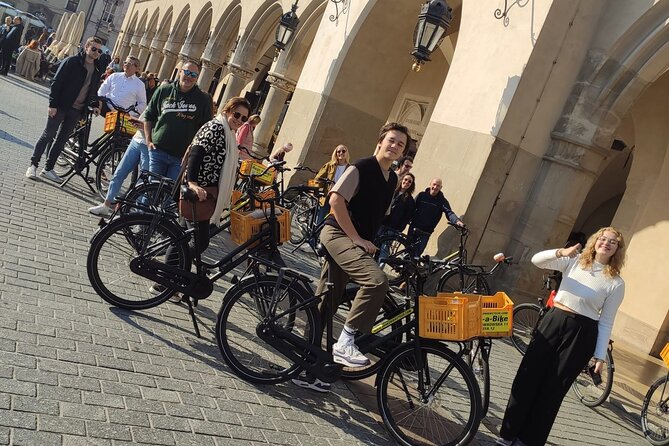
Kraków is best seen with wheels. This Dutch-guided bike tour strings together the city’s most important landmarks in a way that feels both fast and personal—especially once you move from the old center to Kazimierz and the former ghetto, then finish at Kraków’s medieval defenses.
What I like most is the balance: you cover major places like Rynek Główny and Wawel, but you also get the stories behind them, including the darker ones around the ghetto and Oskar Schindler’s world.
One thing to plan for: the tour is about highlights in a few hours, and some entries are not included (notably the Schindler’s Enamel Factory), plus there’s an extra fee if you choose an e-bike.
In This Review
- Key things you’ll notice on this Kraków bike tour
- Why Kraków by bike beats foot sightseeing
- Start in Stare Miasto and roll straight into Rynek Główny
- What to watch for
- Collegium Maius and Maria Magdalena Square: Kraków’s academic and architectural side
- The payoff
- Wawel Hill: dragon myths and the royal seat of power
- A practical tip
- Kazimierz and the former Jewish district: history with street-level texture
- Schindler’s List passage, the ghetto wall fragment, and Plac Bohaterów Getta
- How to handle the mood
- Fabryka Emalia Oskara Schindlera and the practical value of a food break
- Small reality check
- Father Bernatek’s Bridge, Planty-area greenery, and a calmer rhythm
- Barbican fragments and St. Florian’s Gate: medieval defenses close out the ride
- Why I like this ending
- Dutch-speaking guides and the storytelling that makes it feel personal
- Price and value: what you get for $31.53 and what costs extra
- Who the price fits best
- Who should book this Kraków bike tour (and who might skip)
- Should you book? My practical take
- FAQ
- How long is the bike tour?
- What does the tour cost?
- Are bicycles included?
- Is a guide included, and is it Dutch?
- Are e-bikes available?
- Is the Schindler’s Enamel Factory ticket included?
- Do I need tickets for the synagogue stop?
- Where does the tour start?
- When you finish, do you return to the same area?
- What if I cancel?
Key things you’ll notice on this Kraków bike tour
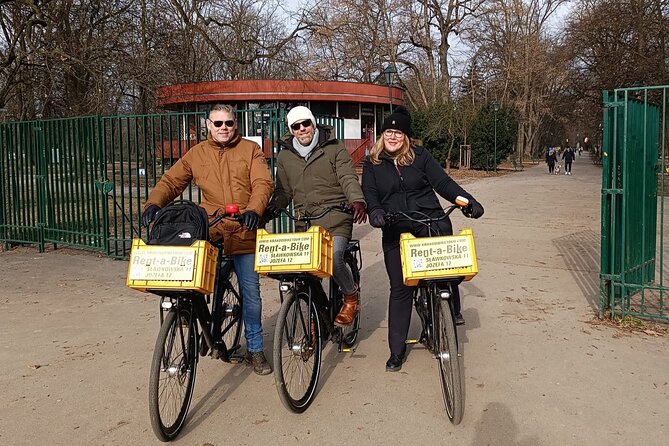
- Dutch-speaking guides who talk with energy (Johan, Wesley, Max, and Jeroen show up in the feedback, and the tone is consistent)
- Old Town + Kazimierz in one loop, so you don’t waste a day hopping neighborhoods on foot
- Rynek Główny legends and Cold War-era stories, including a guide’s take on Stalin and Lenin
- Wawel dragon myth with a clever twist, not just a photo stop
- Former ghetto reminders handled with pauses, including the Plac Bohaterów Getta area and a ghetto wall fragment
- A practical break where you can taste zapiekanka, so you keep riding without running on empty
A few more Krakow trips worth putting on the shortlist
- Complete Cracow Bike Tour (small group of maximum 15 people!)
★ 5.0 · 1,322 reviews - Krakow: Bike Tour of Old Town, Jewish Quarter and the Ghetto
★ 4.9 · 1,155 reviews - Highlights of Krakow Bike Tour – Small group
★ 5.0 · 662 reviews
Why Kraków by bike beats foot sightseeing
Kraków is the kind of city where “one more street” can turn into an hour of walking. On a bike tour like this, you keep your momentum, so you can actually see the big sights and the in-between corners that make neighborhoods feel real.
The ride also changes how history lands. When you’re cycling past city walls, bridges, and gates, the past feels less like a list and more like a living map. And with a group size capped at 20, it stays organized instead of feeling chaotic.
Safety seems well handled in the feedback, and the guides steer the group in a relaxed way. In plain terms: you’ll spend more energy looking up and less energy figuring out where to go.
Start in Stare Miasto and roll straight into Rynek Główny
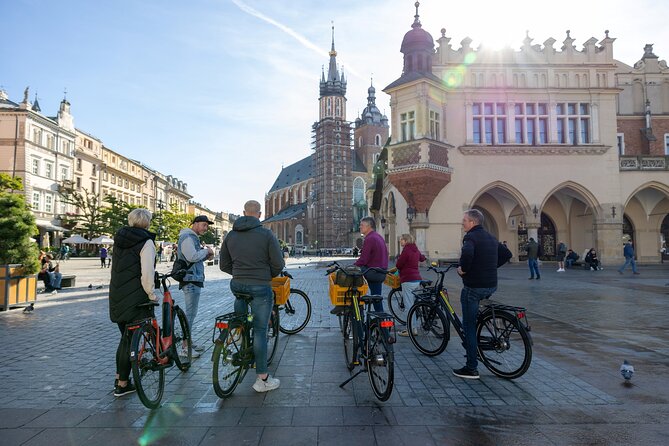
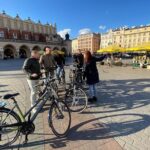
You begin at a central meeting spot on Garbarska Street, at Hotel Alexander. There’s time to get settled, grab a proper-fitting bike, and use the restroom before you start—small detail, but it matters once you’re riding for a few hours.
From there, the first big hit is Rynek Główny, described by many as the largest medieval market square in Europe. You’ll look up at the Cloth Hall, the Town Hall Tower, and St. Mary’s Basilica, and your guide ties it together with how trade worked back then.
One of the fun specifics here is the guide’s storytelling style, including a legend about a trumpeter. You’ll also hear a surprising historical thread—stories involving Stalin and Lenin—so the square isn’t treated as a purely medieval postcard.
What to watch for
Market squares are busy areas. You’ll likely spend a few minutes at the main points, not an hour, so come prepared to soak up key facts quickly and then keep moving.
A few more Krakow trips worth putting on the shortlist
- Krakow: Auschwitz-Birkenau Guided Tour with Pickup & Lunch★ 4.5 · 9,800 reviews
- Krakow: Auschwitz-Birkenau Guided Tour Pickup/Lunch Options★ 4.5 · 9,057 reviews
- Krakow: Auschwitz-Birkenau and Salt Mine Guided Tour★ 4.7 · 9,020 reviews
- Krakow to Auschwitz Birkenau Guided Tour with Transfer and Ticket★ 5.0 · 8,197 reviews
Collegium Maius and Maria Magdalena Square: Kraków’s academic and architectural side
After the square, you move toward one of Kraków’s most famous academic landmarks: Muzeum Uniwersytetu Jagiellonskiego Collegium Maius. This is Poland’s oldest university building, known for its Gothic look, and it’s tied to Copernicus’s time studying there.
Even if you’ve seen photos before, seeing a historic university building in person changes the scale of the story. It helps you understand Kraków as a city that shaped thinkers, not just rulers and empires.
Next comes Plac Świętej Marii Magdaleny—a quieter stop that gives your eyes a break. The guide talks through the history and architecture of the square, so you get the meaning behind what you’re looking at, instead of only ticking off another stop.
The payoff
These two stops are a good reminder that Kraków isn’t only about monuments. It’s also about institutions, streets, and buildings that shaped daily life.
Wawel Hill: dragon myths and the royal seat of power
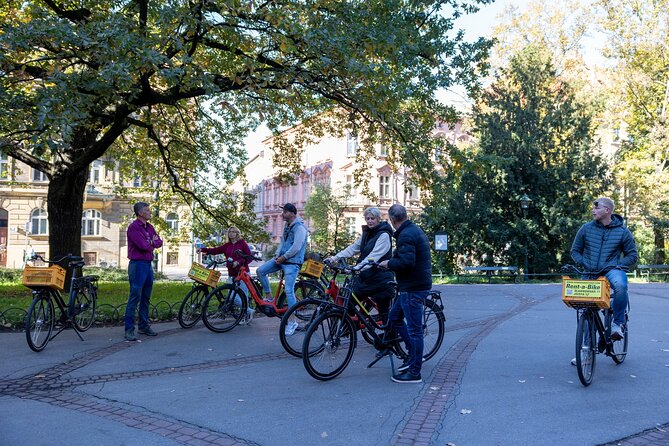
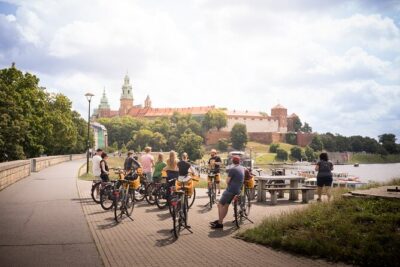
Then you head to Wawel Hill, the royal heart of Poland for centuries. Before you reach the main castle stop, you’ll hear the legend of the Wawel dragon, including how a clever craftsman managed to outsmart it. It’s the kind of story that makes the myth feel grounded in local imagination.
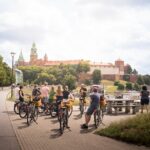
After that, you pause at the Wawel Royal Castle area. The guide explains why this was such a crucial seat of Polish kings and what kinds of legendary stories became attached to the place. Even without entering every room, you’ll understand the site’s importance in a way that screenshots can’t match.
A practical tip
Wawel areas can be windy and exposed depending on the weather. If it’s cold, layer up—your legs warm you up, but your upper body might still feel the chill during pauses.
Kazimierz and the former Jewish district: history with street-level texture
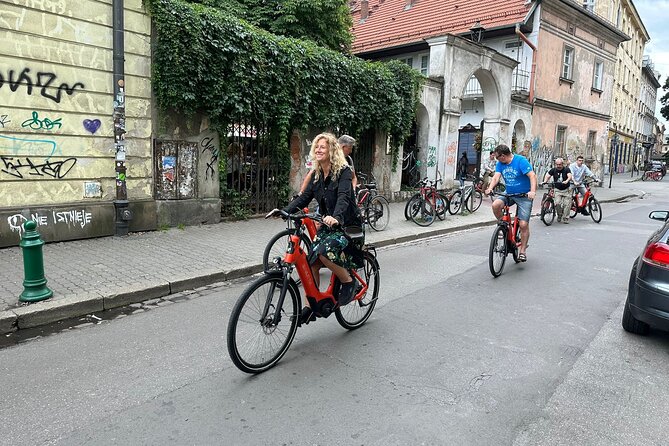
Cycling from the old center into Kazimierz is where the tour becomes more than sightseeing. You reach Plac Wolnica, the historic market square at the heart of Jewish life in Kraków. The guide helps you imagine it during its busiest days, with stalls trading in things like furs, tobacco, salt, and amber, and also where legal and administrative activity took place.
Today, Kazimierz has a creative, artsy, café-lined feel. That modern energy matters, because it shows how neighborhoods adapt instead of turning into frozen museum zones.
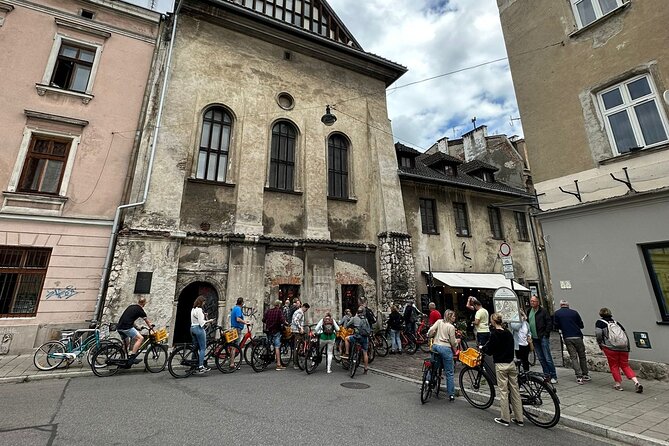
You also get a closer look at Jewish history through stops connected to the Old Synagogue (Stara Synagoga) area. The tour includes time for the guide’s context, but the synagogue admission itself isn’t included—so if you want to go inside, you may need separate tickets.
And then comes the most important part of the route: the areas that connect to the ghetto and its victims. This isn’t taught as trivia. The guide offers historical framing, and the pacing gives you moments to process rather than just roll on by.
Schindler’s List passage, the ghetto wall fragment, and Plac Bohaterów Getta
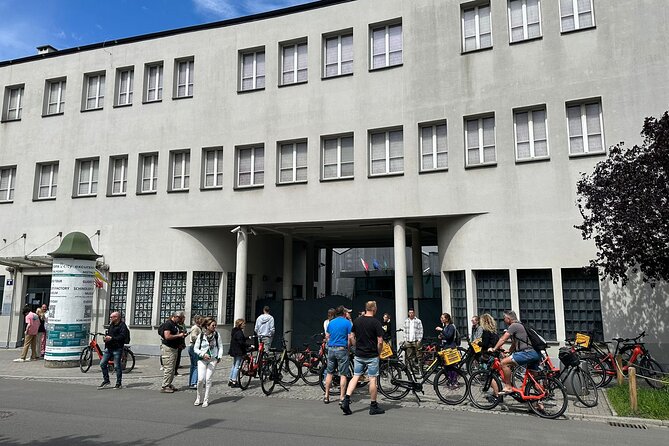
One of the most striking stops is the Schindler’s List passage—a place made famous by Spielberg’s film. The guide has you pause and reflect on why this location matters, both historically and in how the story reached wider audiences.
Next you arrive at Plac Bohaterów Getta, the memorial area dedicated to the ghetto’s victims. There’s also mention of the Pharmacy Under the Eagle, adding a concrete reminder that the ghetto wasn’t only suffering—it was also life under extreme conditions, including commerce and daily needs.
Then you see a fragment of the ghetto wall. Even as a small section, it hits hard because you can physically register that something stood here, restricted here, and defined movement for people forced into it.
How to handle the mood
If you know you’re sensitive to heavy historical topics, plan to take a slower moment at each remembrance stop. The tour moves efficiently, but you control how long you stand and read what’s in front of you during the pauses.
Fabryka Emalia Oskara Schindlera and the practical value of a food break
The route includes a stop at Fabryka Emalia Oskara Schindlera—Oskar Schindler’s Enamel Factory. The time on location is part of the story, but the entrance fee for the factory isn’t included, so build that into your plan if you decide you want to go in.
What I appreciate about this setup is that it gives context even before you commit to paid entry. You’ll likely be better prepared to understand what you’re seeing, because the guide sets up the background first.
You also get a chance for a break where you can taste zapiekanka, a real Polish street-style dish. This is the kind of mid-tour stop that keeps the energy up and prevents the “bike tour fatigue” slump. You can enjoy food without losing too much time.
Small reality check
This isn’t a slow day in museums. It’s a moving tour designed to cover key points in a few hours, so think of paid entrances as add-ons, not the core of the experience.
Father Bernatek’s Bridge, Planty-area greenery, and a calmer rhythm
Between the heavy historical stops, the tour adds breathing space. You’ll ride through a green area around the old town center, described as a relaxed stretch—useful when your brain needs a break after dense history.
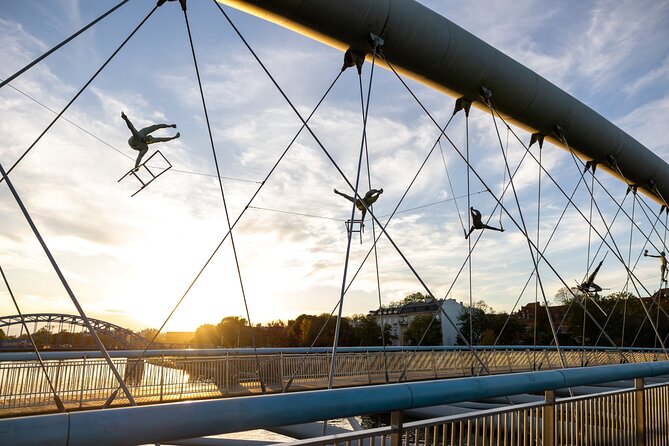
There’s also a beautiful modern pause at Father Bernatek’s Bridge (Kładka Ojca Bernatka). It’s a great contrast to the medieval squares and castle hill: same city, different mood. Bridges are also practical in a bike tour because they give you open views while the group regroups.
If the weather is good, these calmer stretches are when you’ll start enjoying the ride itself, not only the stops.
Barbican fragments and St. Florian’s Gate: medieval defenses close out the ride
As you head toward the end, the route shifts to Kraków’s medieval fortifications. You’ll see remaining fragments of the medieval city walls, including stops connected to the Barbican and the Museum of Krakow area. The guide explains how these walls protected the city and how they shaped movement.
Then you end with St. Florian’s Gate, a key medieval entrance. Even from the outside, it helps you understand Kraków’s city layout—where people entered, where boundaries formed, and why gates became symbols of power and safety.
After that, the tour wraps back at the bike rental area near Sławkowska, and you finish back at the meeting point in the center.
Why I like this ending
The last stops give you a sense of closure. It’s easier to remember a city when you’ve seen the defensive boundaries and the main approach points—not only the interiors and squares.
Dutch-speaking guides and the storytelling that makes it feel personal
A big part of the value here is the guide style. Feedback consistently highlights Dutch-speaking guides with passion and lots of facts, plus the ability to answer questions. Names that came up include Johan, Wesley, Max, and Jeroen—and the common theme is enthusiasm paired with structure.
One reason this works so well is that the tour isn’t only “look here, photo now.” The guide ties each stop to bigger themes: trade, royal power, academia, myth, and the ghetto. So even if you only remember a few key points afterward, you remember why they mattered.
You also get flexibility if you’re curious. People highlighted having questions answered and enjoying special facts beyond the main script. That kind of interaction can turn a good tour into one you remember longer than the photos folder.
Price and value: what you get for $31.53 and what costs extra
At about $31.53 per person for roughly 3 to 3.5 hours, this is strong value for a guided bike loop that covers major Old Town landmarks plus Kazimierz and ghetto memorial areas. You’re paying for orientation and context, not just transportation.
What’s included is straightforward and useful: your bicycle and a Dutch guide. That means you’re not spending energy renting equipment or trying to figure out routes in a crowded historic core.
What can cost extra:
- E-bike fee: €15 if you choose the electric option
- Schindler’s Enamel Factory entrance: not included
- Old Synagogue (Stara Synagoga): the synagogue admission isn’t included for the stop tied to it
So the best way to think about the price is this: you’re buying the guided route and the key context stops, and you’ll decide on entrances based on your interests and time.
Who the price fits best
If you want an overview fast—especially on a short Kraków visit—this tends to be a smart spend. If you’re the type who needs lots of museum time, you can still do it, but treat it as the setup day.
Who should book this Kraków bike tour (and who might skip)
This tour is ideal if you:
- want a big Kraków overview in half a day
- like history told through real city spaces (squares, gates, walls, bridges)
- are curious about Kazimierz and the former Jewish ghetto, and you want a guide to frame it responsibly
- plan to visit Auschwitz/Birkenau and want Kraków context first
You might skip it if:
- you want long museum hours at each site (this runs on a tight clock)
- you’re mainly interested in one paid indoor attraction (you may end up paying extra anyway)
- you don’t feel comfortable biking for a few hours, even with “most participants can take part” guidance
Should you book? My practical take
Yes, I’d book it if it’s your first time in Kraków or if you only have limited time. The route is built to show you the city’s main layers—Old Town, royal Wawel, academic Kraków, Kazimierz, and the memorial-heavy ghetto story—without turning into a nonstop walking day.
The biggest reason to choose it is the Dutch guide approach. When guides can keep stories clear and answer questions, the tour becomes more than movement. It turns into understanding, with time to see what you’ll want to revisit on your own later.
If you book, plan your expectations like this: you’ll learn a lot in a few hours, and then you’ll have a shortlist of places worth returning to deeper.
FAQ
How long is the bike tour?
It runs about 3 hours to 3 hours 30 minutes.
What does the tour cost?
The price listed is $31.53 per person.
Are bicycles included?
Yes. Bicycle use is included.
Is a guide included, and is it Dutch?
Yes. The tour includes a Dutch guide.
Are e-bikes available?
An e-bike option exists, with an extra fee of €15.00.
Is the Schindler’s Enamel Factory ticket included?
No. The entrance fee for Schindler’s Enamel Factory is not included.
Do I need tickets for the synagogue stop?
Admission for the Old Synagogue (Stara Synagoga) is not included.
Where does the tour start?
The tour starts at Hotel Alexander, Garbarska 18, 31-131 Kraków, Poland.
When you finish, do you return to the same area?
Yes. The activity ends back at the meeting point.
What if I cancel?
You can cancel up to 24 hours in advance for a full refund.
More Guided in Krakow
More Cycling Tours in Krakow

More Tour Reviews in Krakow
Just added: fresh Krakow reviews
Cycling Tours, compared.
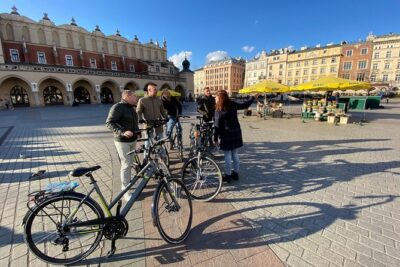 ★ 5.0Complete Cracow Bike Tour (small group of maximum 15 people!)From $391,322 reviews
 ★ 4.9Bike Tour of Old Town, Jewish Quarter and the GhettoFrom $371,155 reviews
 ★ 5.0Highlights of Krakow Bike Tour – Small groupFrom $36662 reviews
 ★ 5.0Full Bike Tour – the Old Town, Jewish Qtr & the Ghetto NEW BIKESFrom $35437 reviews
 ★ 4.9Highlights of Krakow Bike Tour – Small GroupFrom $39421 reviews
 ★ 5.0Hidden Krakow Bike TourFrom $39275 reviews
 ★ 5.0Private Bike Tour in KrakowFrom $151152 reviews
 ★ 4.83-Hour Small Group Tour on E-BikeFrom $62135 reviews
Browse the lists this tour appears in