
REVIEW · SCHINDLER'S FACTORY & WWII TOURS
Tour via Kazimierz Quarter by Golf Cart with Schindler’s Museum in Krakow
Krakow’s past moves at golf-cart speed. I like that you get a smooth Kazimierz orientation without spending the whole afternoon walking, and I also like the museum format: a live guide plus an audio-guided city segment that keeps the story clear. The one trade-off is that part of your time is walking inside the museum, and the day ends at the museum location with no return ride included.
You’ll start in the Kazimierz Quarter and connect the dots from centuries of Jewish life to the Nazi ghetto system, then step into Schindler’s Factory Museum with its hands-on, multimedia-style scenes. For 3 hours (about), it’s a compact way to cover a lot of ground—especially if you’re aiming to see more than just the postcard stops.
In This Review
- Key highlights I’d plan around
- Golf cart orientation in Kazimierz: less slog, more sense
- Szeroka Street and the synagogues story you can picture
- Plac Nowy: from Jewish Square to today’s food, markets, and beer-garden vibe
- The ghetto wall fragment and Umschlagplatz: the story gets darker
- Entering Schindler’s Factory: a setting tied to Deutsche Emailwarenfabrik
- The museum’s multimedia route: from daily details to Płaszów
- Price and what you really get for $81.88
- Logistics that can make or break your day
- Who should book this tour
- Should you book it? My practical take
- FAQ
- How long is the Kazimierz Quarter and Schindler’s Museum tour?
- Is the tour offered in English?
- Where do I meet the group, and where does the tour end?
- What’s included in the price?
- Do I need my passport or ID?
- Is there walking involved?
- Is cancellation free?
Key highlights I’d plan around
- Golf cart + audio guide in Kazimierz: fast orientation through the neighborhood’s streets.
- Szeroka Street context: you’ll hear why this street mattered, including the idea that four synagogues once stood here.
- Plac Nowy’s layered identity: from Jewish Square to food-and-market square you’ll recognize today.
- Ghetto memory stops: you’ll see a preserved wall fragment with a commemorative plaque and learn about Umschlagplatz.
- Schindler’s real factory headquarters: the museum is built around the former German enamel factory setting.
- Multimedia scenes: cobbled streets, a photographer’s atelier, hairdresser, tram, an apartment scene, and the route leading to Płaszów.
Deeper into Kazimierz and its Jewish heritage
- Krakow: Schindler’s Factory & Ghetto Guided Tour
★ 4.7 · 1,694 reviews - Krakow: Jewish Quarter and Former Ghetto Tour
★ 4.9 · 1,441 reviews - Krakow: Bike Tour of Old Town, Jewish Quarter and the Ghetto
★ 4.9 · 1,155 reviews
Golf cart orientation in Kazimierz: less slog, more sense
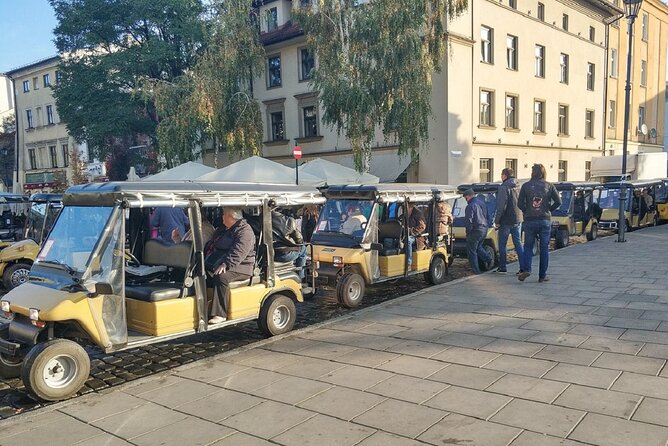
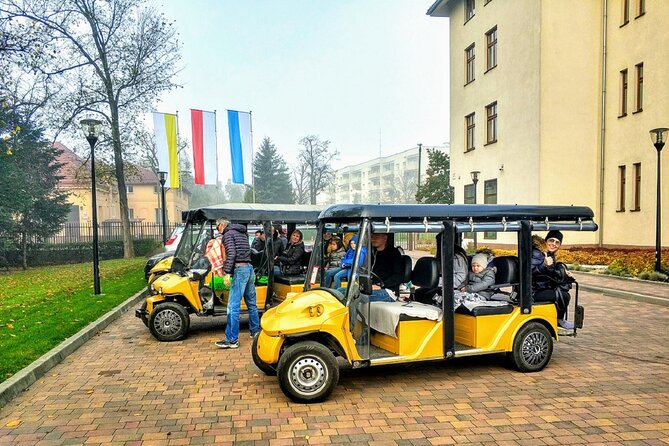
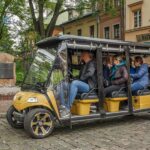
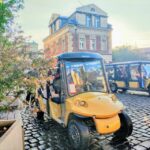
This tour is built around Kazimierz, Krakow’s historic Jewish Quarter, and it’s smart about how you move through it. Instead of forcing a long, slow march right away, you ride in a golf cart while an audio guide helps you follow along. The payoff is practical: you see more streets and key corners without your day turning into sore-feet management.
Kazimierz itself sits south of Wawel, and your route helps you understand that this wasn’t just a single “attraction area.” It was a real district that shaped daily life for centuries, and the tour uses that idea to connect before-and-after. You’ll leave with the feeling that the area’s layout matters—because the places you stop aren’t random dots on a map; they connect to social life, markets, worship, and then, tragically, displacement and deportation.
One detail I really like is the human element on the cart. In past tours, the golf-cart driver has brought serious historical perspective, including one driver who was born about three months after the war ended. That kind of context doesn’t replace the museum; it makes the streets feel personal and anchored.
Two small planning notes: the tour is a group experience with a maximum of 24 people, and there’s some walking inside the museum. If you’re used to city strolls, you should be fine, but don’t treat this as a fully seated outing.
Szeroka Street and the synagogues story you can picture
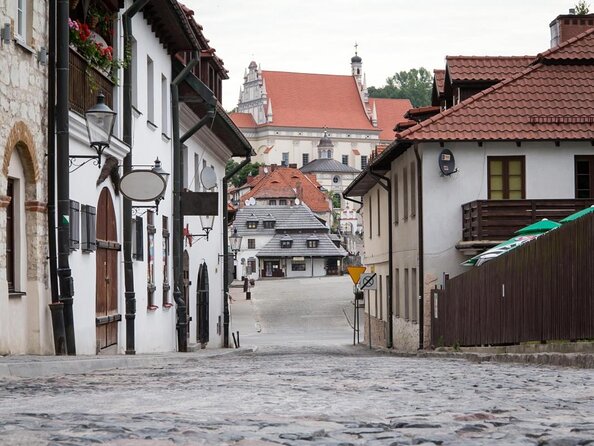
Your first major stop is in Kazimierz’s core, with Szeroka Street as the centerpiece. This street is described as the heart of Jewish Kazimierz, and you’ll learn a striking point: four synagogues used to stand on Szeroka Street—an arrangement described as unheard of anywhere else in Europe. Even if you know Krakow has major Jewish heritage sites, this specific detail gives you a clearer sense of how concentrated religious life once was.
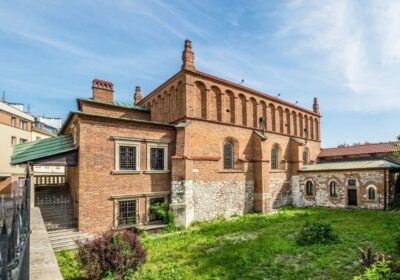
From there, the tour brings you to another key moment on Szeroka Street: one of the oldest synagogues in Poland preserved in very good condition. The explanation also links the building to modern Jewish Culture Festival events, including the fact it hosted the final concert of the festival. That connection matters. It’s easy to see old buildings as only museum pieces. The tour nudges you to see continuity—memory plus community.
What I like here is the pacing. You’re not just reading plaques. You’re learning what the street functioned as—where worship and community gathered—and then you get to keep that in mind as the tour moves toward squares, markets, and later the ghetto system.
Plac Nowy: from Jewish Square to today’s food, markets, and beer-garden vibe
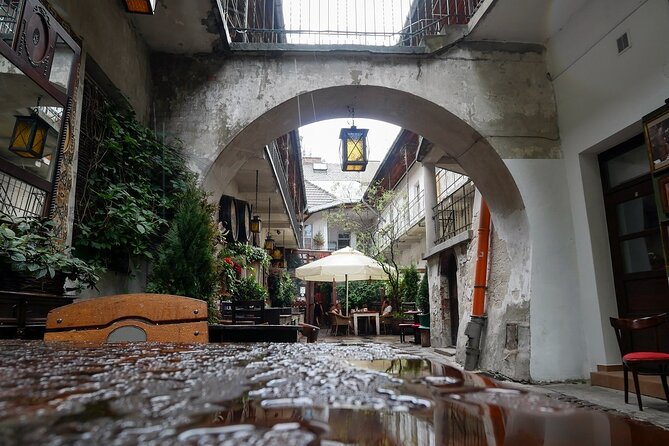
Next comes Plac Nowy, a square that feels lively in the present and layered in the past. The tour explains that Plac Nowy was once called Plac Żydowski (Jewish Square), which instantly helps you stop thinking of Kazimierz heritage as only “historic buildings.” This was everyday life.
You’ll learn about a circular pavilion built in 1900 in the middle of the square, with small grocery and butcher shops and a fast-food bar known for delicious casseroles—something famous in Krakow today. That detail is the kind of thing that sticks because it’s not abstract. It tells you what people ate, where they shopped, and how the square worked day-to-day.
Then the tour gives you a sense of how the square changes by day:
- On weekdays, it’s described as filled with stalls selling vegetables and antiques.
- On Sunday mornings, it turns into a clothing market.
- In warm summer nights, cafés and pubs around the square spill out and the area takes on a beer-garden feel.
Even if your timing doesn’t match peak market hours, the explanation helps you see why Plac Nowy is a natural hangout today. It also gives you a lens for understanding the later stops—because when you know how a community lived in public spaces, the transition to the ghetto system lands harder.
More of Krakow under the wartime occupation
- Krakow: Schindler’s Factory Ticket and Guided Tour Option★ 4.3 · 4,306 reviews
- Krakow: Schindler’s Factory Tour with Entrance Ticket★ 4.5 · 3,182 reviews
- Krakow: Schindler’s Factory Skip-the-Line Ticket★ 4.4 · 3,105 reviews
- Krakow: Schindler’s Factory Tour with Entrance Ticket★ 4.6 · 1,737 reviews
The ghetto wall fragment and Umschlagplatz: the story gets darker
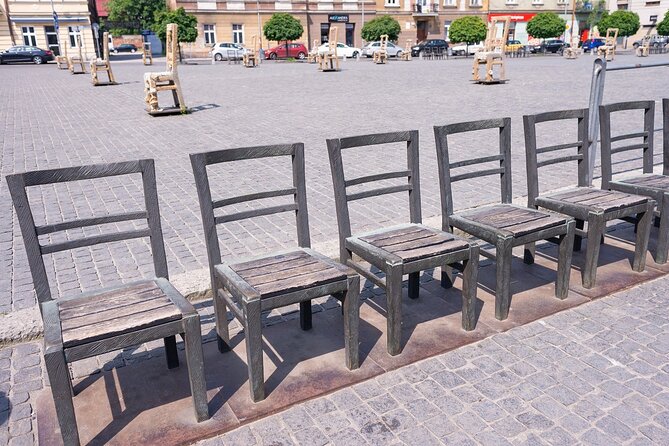
After the cultural and social focus of Kazimierz, the tour turns to the forced, brutal machinery of the Nazi occupation. You’ll pause at a small preserved fragment of the original wall around the former ghetto, with a plaque commemorating the fate of the inhabitants. It’s not a huge monument, but the tour treats it with weight. The preservation is part of the message: this is a wound that still has a physical boundary in the city.
From there, you’ll move to Podgórze, explained as the district that, in 1941, was turned into the Krakow Ghetto. The tour also points out Plac Zgody (Concord Square) as the site designated Umschlagplatz, the place where Jews had to gather before deportation.
This is the part of the tour where I think the structure really helps. You’ve spent time understanding the places that held community life—streets, squares, markets—so when the narrative shifts to forced congregation, it doesn’t feel like a separate topic. It feels like the same city, under a different system of cruelty.
Be ready for an emotional tone here. It’s history with real names behind it, and the museum portion later keeps that intensity moving forward.
Entering Schindler’s Factory: a setting tied to Deutsche Emailwarenfabrik
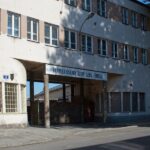
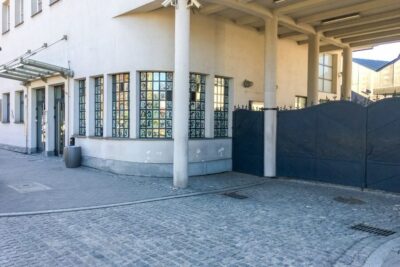
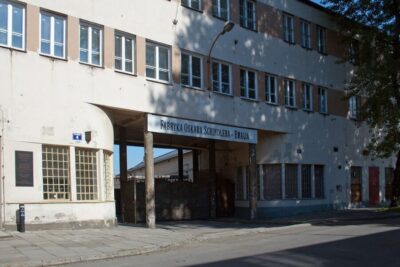
Your second half is anchored at Fabryka Emalia Oskara Schindlera (Schindler’s Factory Museum). The museum visit is where the story becomes grounded in place, because you’re touring the real headquarters of Deutsche Emailwarenfabrik—the former German enamel factory linked to Oskar Schindler.
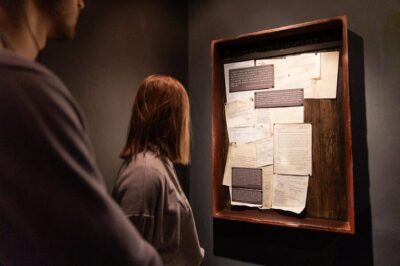
A key point you’ll hear is about Schindler himself: an entrepreneur known from the Oscar-winning Spielberg film, credited here as someone who saved many of his employees from inevitable death. Even if you’ve seen the movie, the museum framing matters because it returns the story to documents, setting, and the lived reality of people inside that system.
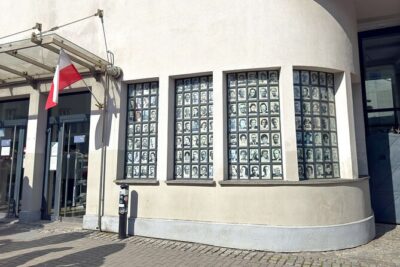
The tour also describes the factory’s preserved office area and a symbolic “ark of survivors” made of thousands of pots like those made by Schindler’s employees during the war. That imagery isn’t just decorative. It’s a way of translating industrial production into human survival—turning a factory’s output into a record of who was protected.
What I like about this museum stop is that it’s not only about hero narratives. The tour’s message stresses everyday life in multicultural Krakow and how world events changed ordinary routines. That makes the history feel legible, even if you’re not a deep-Poland WWII-history buff.
The museum’s multimedia route: from daily details to Płaszów
Inside the museum, you get a live guide, which is a big deal for a site this heavy. An audio guide alone can work, but in a museum like this, a live person can stop and explain what you’re seeing and why it matters. If you want to make sure you fully connect the scenes to the broader story, the live guide helps.
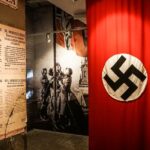
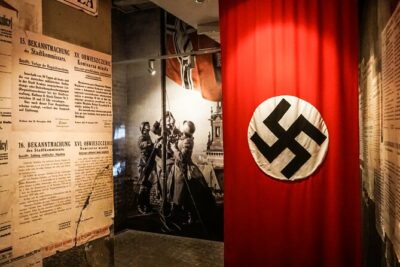
The tour also highlights a modern multimedia installation that takes you through staged environments and experiences, including:
- Walking along cobbled streets
- Entering a photographer’s atelier
- Visiting a hairdresser
- Getting on a tram
- Seeing a typical apartment in the Jewish ghetto
- Then moving to where inhabitants ended up in the Płaszów camp story line
If you’re the type who worries that “multimedia” can turn history into entertainment, this museum route is worth approaching with an open mind. The point isn’t flashy tech for its own sake. It’s the museum using sensory, everyday details—shops, streets, transit, rooms—to show you how quickly life can be organized and destroyed.
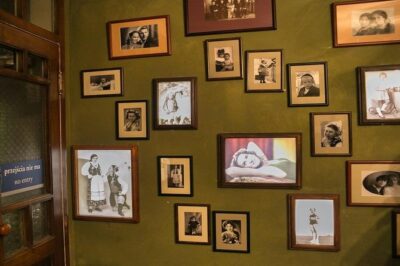
The specific mix of settings—atelier, hairdresser, tram—matters because it keeps the narrative rooted in normal behavior: people go to work, get services, travel, live somewhere. Then the story becomes about the forced structures that replaced normal life.
Price and what you really get for $81.88
At $81.88 per person for about 3 hours, this tour is priced more like a “guided experience + tickets” package than a basic walking tour. The inclusion list is doing real work here:
- Transportation by golf cart through Kazimierz
- Audio guide (during the cart portion)
- Live guide (at the museum)
- Entrance ticket to Schindler’s Factory Museum
That combination is usually where value hides. You’re not paying extra for separate components. Instead, one price covers movement, interpretation, and entry. If you’re thinking about doing Kazimierz on your own and then taking a separate museum tour, the bundled structure can help your time—and your sanity.
Also worth noting: this is offered in English, and the group size is capped at 24 travelers, which tends to keep it from feeling like a moving crowd with no personal attention.
One more planning detail: the meeting point is at Mikołaja Zyblikiewicza 2. The tour ends at Lipowa 4 (with the museum visit), and you won’t get transport back to your hotel afterward. If your hotel is far from the museum area, plan the rest of the evening around walking or local transit.
Logistics that can make or break your day
A few practical points matter with this particular format:
- Name matching for tickets: Schindler’s Factory Museum uses personalized tickets, so you must provide full names when reserving and bring a passport or ID for entry. If names don’t match, entry may be denied.
- Bring ID even if you think you won’t need it: museum staff check identification.
- No large bags/backpacks: keep it light.
- Times are approximate: the schedule can shift due to museum timing. From January 1, 2026, times are approximate and may change with museum scheduling, even if you choose a preferred time.
Finally, be on time at the meeting point. This is a group tour that starts at the specified time, and it runs on a tight flow: cart portion first, then the museum.
Who should book this tour
This one fits best if you want:
- A guided connection between Kazimierz’s Jewish heritage sites and the later ghetto history
- Museum interpretation with a live guide
- A format that reduces walking in Kazimierz without removing the key stops
I’d especially recommend it if you’re visiting Krakow for a short time and want your day to feel structured, not stitched together by half-planned stops.
If you prefer totally self-paced travel and don’t like group timing, you might feel constrained—there’s a firm schedule and a set end point at the museum.
Should you book it? My practical take
Book it if you want a straightforward route that connects the neighborhood’s cultural life to the ghetto system, and then gives you a museum visit you can actually follow. The value is in the combo: golf-cart orientation, audio + live guidance, and entry included for Schindler’s Factory Museum.
Skip or rethink it only if you can’t manage light walking inside the museum or you don’t want to handle the ID and name-matching requirement. Otherwise, this is a strong choice for people who want clarity and context without turning the day into logistics chaos.
FAQ
How long is the Kazimierz Quarter and Schindler’s Museum tour?
It runs for about 3 hours.
Is the tour offered in English?
Yes, the tour is offered in English.
Where do I meet the group, and where does the tour end?
You start at Mikołaja Zyblikiewicza 2, and the tour ends at Lipowa 4, after visiting Schindler’s Factory Museum.
What’s included in the price?
It includes transportation by golf cart through Kazimierz, an audio guide (during the cart portion), a live guide at the museum, and the entrance ticket to Schindler’s Factory Museum.
Do I need my passport or ID?
Yes. Schindler’s Factory Museum uses personalized tickets, so you must bring a passport or ID for entry, and the name on your ticket must match your document.
Is there walking involved?
Yes. Part of the tour includes walking inside the museum. The tour notes a moderate physical fitness level is recommended.
Is cancellation free?
Yes. You can cancel for a full refund if you cancel at least 24 hours before the experience’s start time, and cancellations up to 24 hours in advance are free.
The Old Town by Electric Cart
Krakow in Wartime: More Reviews
More of Jewish Kazimierz

Just added: fresh Krakow reviews
Schindler's Factory & WWII Tours, compared.
 ★ 4.3Schindler’s Factory Ticket and Guided Tour OptionFrom $254,306 reviews
 ★ 4.5Schindler’s Factory Tour with Entrance TicketFrom $493,182 reviews
 ★ 4.4Schindler’s Factory Skip-the-Line TicketFrom $253,105 reviews
★ 4.6Schindler’s Factory Tour with Entrance TicketFrom $401,737 reviews
★ 4.4Schindler’s Factory Skip-the-Line TicketFrom $253,105 reviews
★ 4.6Schindler’s Factory Tour with Entrance TicketFrom $401,737 reviews
 ★ 4.5Schindler’s Factory in Krakow: Guided Tour & Skip the Line TicketFrom $351,714 reviews
 ★ 4.7Schindler’s Factory & Ghetto Guided TourFrom $571,694 reviews
 ★ 4.3Schindler’s Factory Ticket with Guided Tour OptionFrom $421,485 reviews
 ★ 4.0Krakow Schindler’s Factory Guided Tour with Admission TicketFrom $351,156 reviews
Browse the lists this tour appears in